
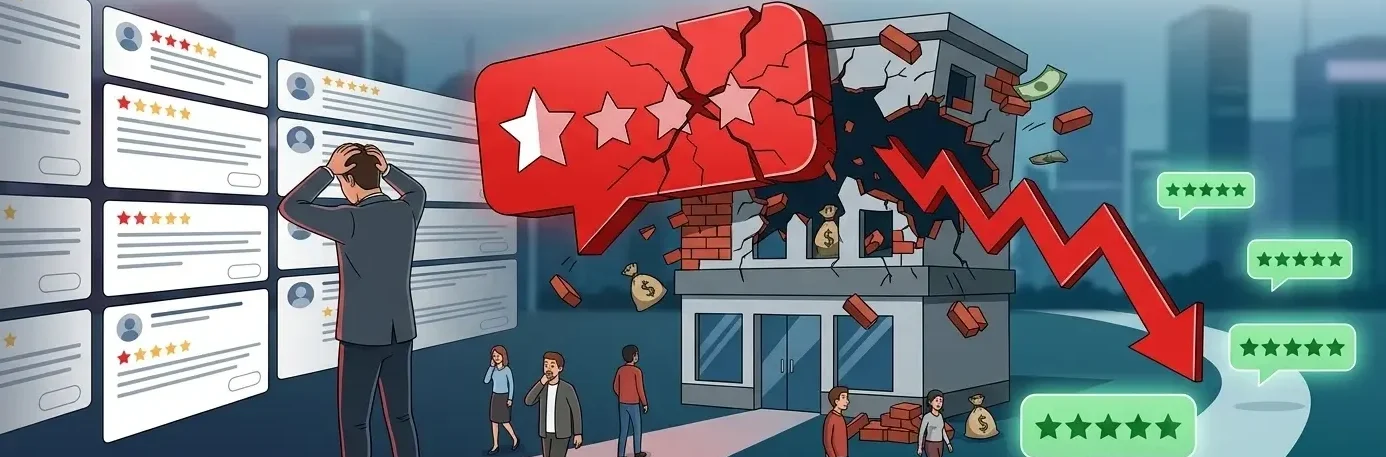
Bad Reviews Are Hurting Your Business More Than You Think
You search your own business name on Google. Maybe a client went quiet, maybe someone mentioned it, whatever the reason, you looked. And there it is. A two-star review, sitting right under your business name. Public. Permanent.
In Dubai, that stings more than most places. This city runs on reputation. That review loads before your website, before your portfolio, before anything you’ve built and the person searching is already moving on.
The frustrating part isn’t the review itself. It’s that most businesses here have no plan for when it happens. So something fixable in week one quietly becomes the story people associate with your name.
But it doesn’t stay that way. Reviews can be responded to, rankings can be rebuilt, and your online presence can be shaped into something that works for you, not against you.
What a Bad Review Actually Costs You
Most people think a bad review hurts feelings. In Dubai, it hurts business in ways that are very specific to how this city works.
Your Google ranking takes a hit. Google uses review signals to decide who shows up first. A drop in rating or a spike in negative feedback directly affects where you appear in local search and in a market this competitive, page two doesn’t exist for most customers. This is exactly where consistent Google My Business management services make a difference: keeping your profile active, accurate, and responding in a way Google notices.
B2B clients quietly walk away
Dubai’s business culture is built on trust and referrals. A corporate client or procurement team will search for you before any meeting. One unaddressed review, especially with no response, reads as negligence, not just a bad day.
Tourists and expats don’t give second chances
A huge portion of Dubai’s consumer base is transient. They don’t know anyone who can vouch for you personally. Google reviews are their only reference. A weak rating is a closed door before you ever have a conversation.
It spreads faster than you think
Dubai is networked tightly. One review on Google becomes a screenshot on WhatsApp, a mention in an expat Facebook group, a talking point at a business lunch. The damage compounds quietly.
Dubai Doesn’t Let You Hide
In most cities, a bad review fades. A few good ones come in, and people move on. Dubai doesn’t work that way.
The competition here is dense, and the audience is ruthless, not because people are harsh, but because they have too many options to give anyone the benefit of the doubt. A restaurant on JBR, a clinic in Business Bay, a salon in DIFC, every category is flooded. One weak rating and the next option is a tap away.
Then there’s the audience itself. Dubai’s population is over 85% expat. These are people who moved to a new city without a personal network to lean on, so they rely on Google Maps the way locals rely on word of mouth. Your rating isn’t just a number to them. It’s their only signal.
And because the community is so connected through WhatsApp groups, expat forums, and colleague networks, a bad experience doesn’t stay between you and one customer. It travels.
This is why online reputation management services exist specifically for markets like this, not as a luxury, but as a basic business function. Because in Dubai, your Google presence isn’t a reflection of your reputation, it practically is your reputation.
The Three Layers of the Fix
Most businesses try to fix a reputation problem in one move. That’s why it doesn’t work. There are three distinct layers, and they have to happen in order.
Layer 1 — Respond Before It Spreads
The first thing you do is respond to the review. Publicly, calmly, and without being defensive. Don’t argue the facts, don’t apologize excessively just acknowledge, show accountability, and invite them to resolve it offline. One sentence that sounds human does more than a five-line corporate reply. What you don’t do is ignore it, delete it, or respond in anger. Silence reads as guilt. A bad response is worse than no response.
Layer 2 — Rebuild What Got Damaged
A response buys you time. Rebuilding your Google presence is what actually moves the needle. That means keeping your GMB profile updated, consistently generating fresh, positive reviews, and ensuring your business information is accurate everywhere Google looks. This is the layer most businesses skip or do inconsistently, which is exactly why Google My Business management services exist. It’s an ongoing process, not a one-time fix.
Layer 3 — Build Authority They Can’t Ignore
Once the immediate fire is out, the real work begins. Long-term reputation isn’t just about reviews, it’s about what comes up when someone searches your brand name. A Wikipedia page creation for your business adds a layer of credibility that sits above the noise. It signals legitimacy to both users and search engines, and it’s one of the few things that genuinely anchors your brand in search results for the long run.
When DIY Stops Working
Responding to reviews and updating your GMB profile that’s something most businesses can handle early on. But there’s a point where the problem outgrows what you can manage between meetings.
You’ve crossed that line when:
- The reviews keep coming, and positive ones aren’t catching up
- Your rating is affecting your search ranking, and you’re visibly losing ground to competitors
- The damage has spread beyond Google forums, directories, and social mentions
- You’ve responded well, but nothing is shifting; the narrative is already set
- Your business is scaling, and reputation gaps are blocking partnerships, listings, or client approvals
At this point, DIY isn’t a strategy anymore, it’s just hope. This is where online reputation management services come in as an actual business decision, not a marketing upsell. The right service doesn’t just monitor reviews, it rebuilds your presence systematically, manages what shows up when people search you, and creates a buffer so one bad cycle doesn’t define you.
What Separates the Ones That Recover
The businesses that recover cleanest are the ones that recognise this line early and don’t wait until the damage is deep to ask for help.
The businesses that bounce back fast all have one thing in common: they built credibility before the crisis, not after.
They had active GMB profiles, consistent review generation, and an online presence substantial enough that one bad review couldn’t dominate their search results. Some had gone as far as Wikipedia page creation, giving their brand an authoritative anchor that sits above the noise entirely.
The ones that struggle? They built nothing until something broke.
Reputation isn’t a repair job. It’s infrastructure. And the businesses that treat it that way never have to start from zero.
FAQs
How do bad reviews affect my Google ranking in Dubai?
Google uses reviews as a ranking signal. A dropping rating means dropping visibility and in Dubai’s competitive market, that directly translates to lost business.
Can I delete a bad Google review? Only if it violates Google’s policies. Otherwise, the focus should be on responding well and building a strong positive presence so that one review no longer defines you.
When do I need online reputation management services? When the reviews are consistent, spreading, or affecting real outcomes, such as leads, rankings, and client trust. That’s when it moves beyond DIY.
Your Reputation Is a Decision You Make Now
Most businesses wait for something to go wrong before they think about any of this. And that’s understandable, there’s always something more urgent demanding attention.
But the businesses that never panic over a bad review aren’t lucky. They just made decisions earlier. They responded when it was small, built their presence when things were good, and created enough credibility online that one unhappy customer couldn’t undo what they’d spent years building.
You don’t need to overhaul everything today. But if reading this made you think of your own Google profile, your last unanswered review, or what someone finds when they search your name that’s worth acting on.

Yasser Badhaz has spent years helping people to improve their online reputation. He understands the difficulties when negative reviews or incorrect data start to harm your business because he genuinely wants to help others through these challenges. At Reputationshield.ae, he has created detailed guides and blog posts that explain reputation management to readers in the most basic way. Yasser saves his time outside work to learning new information, which enables him to provide optimal solutions for his clients.